Alternate narratives that often don’t make it to museums.
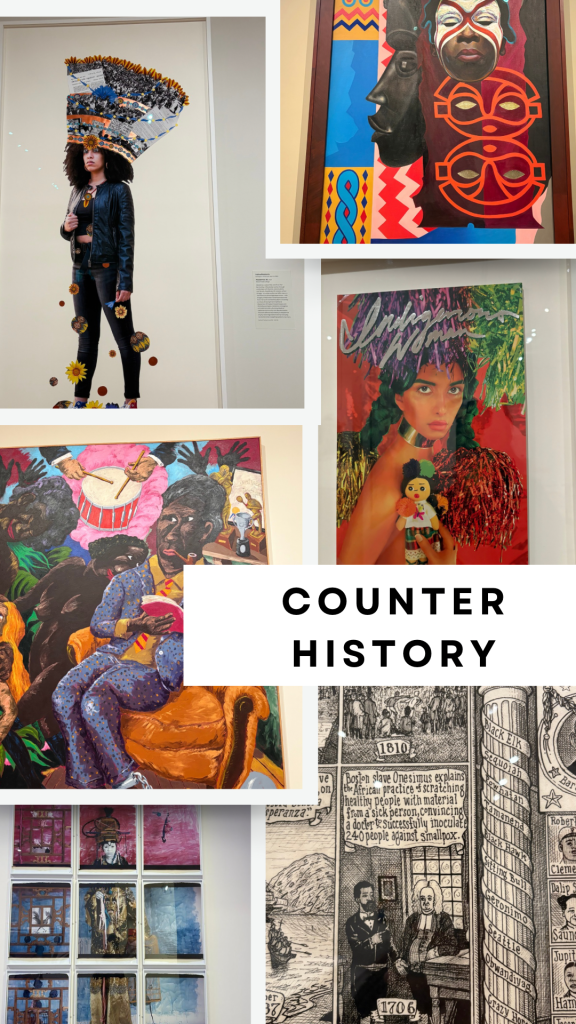
exhibit at MFA, Boston.
I didn’t walk into MFA on a weekday afternoon (navigating through field trips) expecting a huge revelation. At best, I was hoping for some quiet time and my old friend van Gogh convincing me that losing my mind wasn’t so bad after all! A walk through half of the first floor had left me quite satisfied until I stumbled into the Counter History exhibit- and suddenly the museum didn’t feel like a carefully curated series of artefacts on the other side of a glass shelf. It felt like a protest in polite shoes.
Every single piece in that room is an equivalent of clearing one’s throat and saying “Actually it’s not your story to tell”- the kind of interruption that leaves the coloniser’s narrative grasping for a straw. The exhibit creates a deep sense of discomfort, and if you can be patient enough to sit with that feeling and let it stir up the many rightful thoughts inside your head- you will find yourself asking – Whose stories do museums tell? Which parts are left out and why? Who frames these narratives and who pays them to do so? Is this what a museum looks like when it stops pretending to be neutral?
This essay is about precisely that moment- taking control of the narrative that’s lost behind museum-friendly terminologies like ‘donated’ and ‘disputed origin’.
Let’s be honest: museums aren’t neutral. The placement, the curation, the ambient lighting, the captions- are all deeply political. The colonial lingo for ‘Look what I found in your home! Now it’s mine!’ . The end result of centuries of cultural theft curated under one roof. The foundation of many museums are rooted in unethical or exploitative means to acquire most of their exhibits (if not all). The MFA has acknowledged this past and initiated a lot more than just a conversation about repatriation and shared authority. Museums need to sort their bronzes to figure out exactly how many were looted via polite imperialism. But here’s the thing- clearing out your attic isn’t enough; we need to ask why was it deemed okay to turn your conquest into a curation? The space within these museums has never been neutral- it has systemically been representative of whitewashed history, an ally of those with guns and gold.
The Counter History and Unofficial Archives exhibits at MFA take control of that very space- they narrate their story as if to remind us “you have been trained to remember history, but not us”. They don’t ask to be included; they take up space. Rightfully, they demand to be heard. Loudly. Unapologetically. To just be included still means someone else is holding the door; whereas these artists have kicked off the hinges.
There’s a piece in that exhibit that shall forever live rent-free in my head- the excerpt on Onesimus in the installation ‘White out: A Monumental Arch to American History’ by Sandow Birk. Onesimus- the man behind the early inoculation for smallpox in Boston- remains silenced as the covers of popular history books with selective-osmosis forgets that his approach (rooted in African science) saved thousands of lives. Then there is Maria Magdalena Campos-Pons’ work from her installation The Seven Powers Come by the Sea (1992) . The artist shows how European ships were designed cruelly for efficient transportation of enslaved Africans across the Atlantic.
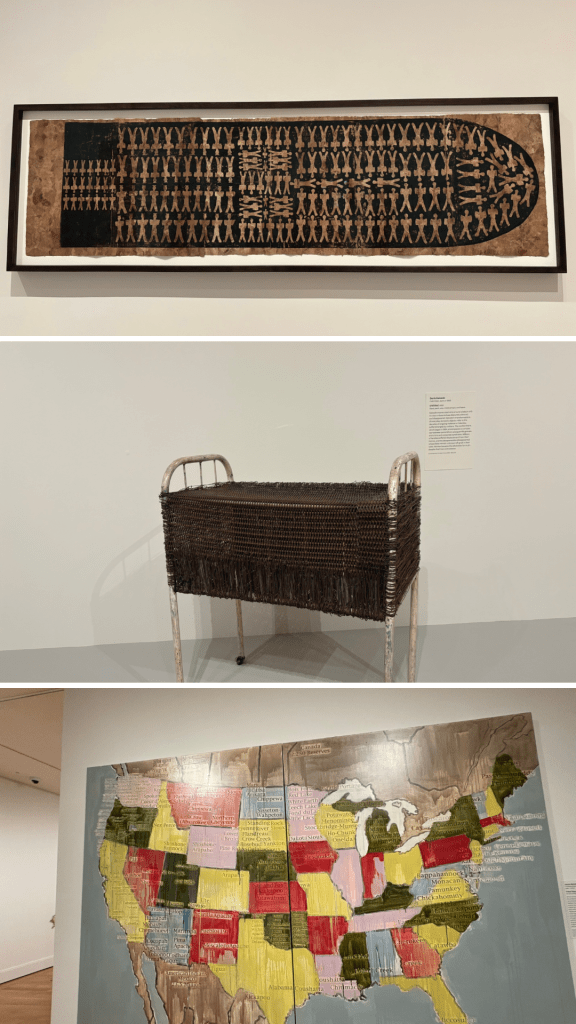
But here’s the thing: these exhibits are the exceptions not the norm.
This is a reality check on all the museums trying to board the decolonisation ship without touching their donor walls. Because when we talk about an alternative history taking over the narratives (as it should have many many years ago) we need to pause and ask, who curates? Who funds? Who writes the labels? And who is forever stuck inside a dusty drawer of archival information far too uncomfortable for the colonial mind?
Decolonisation isn’t just conversations behind closed doors- it’s in the politics of accountability, in shared authority, and in a power shift. It’s in rethinking not what we display but why we display. And what does it mean to prioritise oral histories and community archives over static preservation ?
If you can’t hand over the diamond, atleast hand over the mic!

 Why Kamalika Why!
Leave a comment